Showing posts with label Bat Speed. Show all posts

Monday, September 22, 2025

Correlation between Strength, Size, Bat Speed and Performance in High School Hitters


Study Overview

Objective

  • To investigate the relationships between muscle strength, swing speed, batting statistics, and body composition in high school baseball players.

Participants

  • 29 high school male baseball players, aged approximately 15.9 years, assessed in July 2022.


Methodology

Data Collection

  • Measurements included body composition (body fat percentage, lean body mass [LBM], fat mass index [FMI], fat-free mass index [FFMI]), muscle strength (bench press, squat, deadlift), batting statistics (batting average, on-base percentage, slugging percentage, on-base plus slugging), and swing speed.
  • Used a bioelectrical impedance analyzer for body composition assessments.


Statistical Analysis

  •   Employed Pearson’s and Spearman’s correlation coefficients to analyze relationships.
  •   Conducted multivariate regression analyses to identify significant predictors.


Key Findings

Muscle Strength Correlations

  •   LBM was a significant predictor of bench press and swing speed.
  •   FFMI was a significant predictor for squat performance.
  •   FMI was associated with deadlift performance.


Swing Speed and Batting Statistics

  •   Significant correlations were found between swing speed and LBM, as well as FFMI.
  •   No significant associations were detected between body composition parameters and batting statistics, suggesting that technical skills may be more critical for batting performance.


Discussion Points

Importance of Body Composition

  • Lean body mass is crucial for enhancing swing speed, indicating the need for effective body composition management in training regimens.
  • Despite the correlations with swing speed, body composition did not correlate with batting statistics, highlighting the multifactorial nature of batting performance.


Technical Skills Emphasis 

  • The study recommends prioritizing technical skills over purely physical attributes to improve batting statistics in players.
  • Factors like mental state, game situation, and pitcher skill also influence batting outcomes.


Limitations

Sample Size and Selection Bias

  •   The study's focus on a single team may limit the generalizability of the findings.
  •   Differences in training and coaching approaches across teams could affect results.


Temporal Changes

  • Body composition and performance metrics may vary throughout the season, complicating the attribution of performance outcomes to specific variables.


Measurement Methods

  • The use of cost-effective bioelectrical impedance analyzers may lead to less accurate results compared to more advanced methods.


Practical Applications

Training Recommendations

  • Coaches should integrate body composition management strategies to enhance muscle strength and swing speed.
  • Focus on developing batting mechanics, timing, and adaptability to improve overall batting performance.


This research provides valuable insights for coaches and players, emphasizing the balance between physical conditioning and skill development in high school baseball.


Full article:

Correlation Between Muscle Strength, Swing Speed, Batting Statistics, and Body Composition Parameters in High School Baseball Players: A Retrospective Observational Study

Suzuki, K., Mizoguchi, Y., Kimura, F., Fujisaki, K., Yokoyama, D., Hall, T., & Akasaka, K. (2022). Correlation Between Muscle Strength, Swing Speed, Batting Statistics, and Body Composition Parameters in High School Baseball Players: A Retrospective Observational Study. The Journal of Strength & Conditioning Research, 10-1519.
Tuesday, January 7, 2025

Clench your jaw for more bat speed?

The Effects of Concurrent Activation Potentiation on Bat Swing Velocity of Division II College Softball Athletes

Mace, A. P., & Allen, C. R. (2020). The effects of concurrent activation potentiation on bat swing velocity of division II college softball athletes. International Journal of Exercise Science13(1), 1630.


This study investigated the effects of concurrent activation potentiation (CAP) on bat swing velocity (BSV) in Division II college softball athletes, employing a Zepp sensor to measure the swing's velocity. Thirteen female athletes performed swings using two conditions: with maximal jaw clenching and with relaxed jaw muscles. The Zepp sensor recorded a mean swing velocity of 28.02 m/s (62.68 mph) in the relaxed condition compared to 29.42 m/s (65.82 mph) during the jaw clenching condition, revealing a statistically significant increase of 1.4 m/s (3.14 mph) (p = 0.003). This study demonstrated that maximal jaw clenching effectively enhances BSV, suggesting that athletes may improve their hitting performance through this simple yet impactful technique. Importantly, individual variations in response to the jaw clenching strategy were noted, with ten out of thirteen participants showing improved BSV, highlighting the necessity for athletes to experiment with RVC methods suitable for their unique performance needs. These findings underscore the potential of CAP as a practical ergogenic strategy that can be easily adopted in training for enhanced athletic outcomes across various sports requiring powerful swings.

Article Link

Tuesday, December 31, 2024

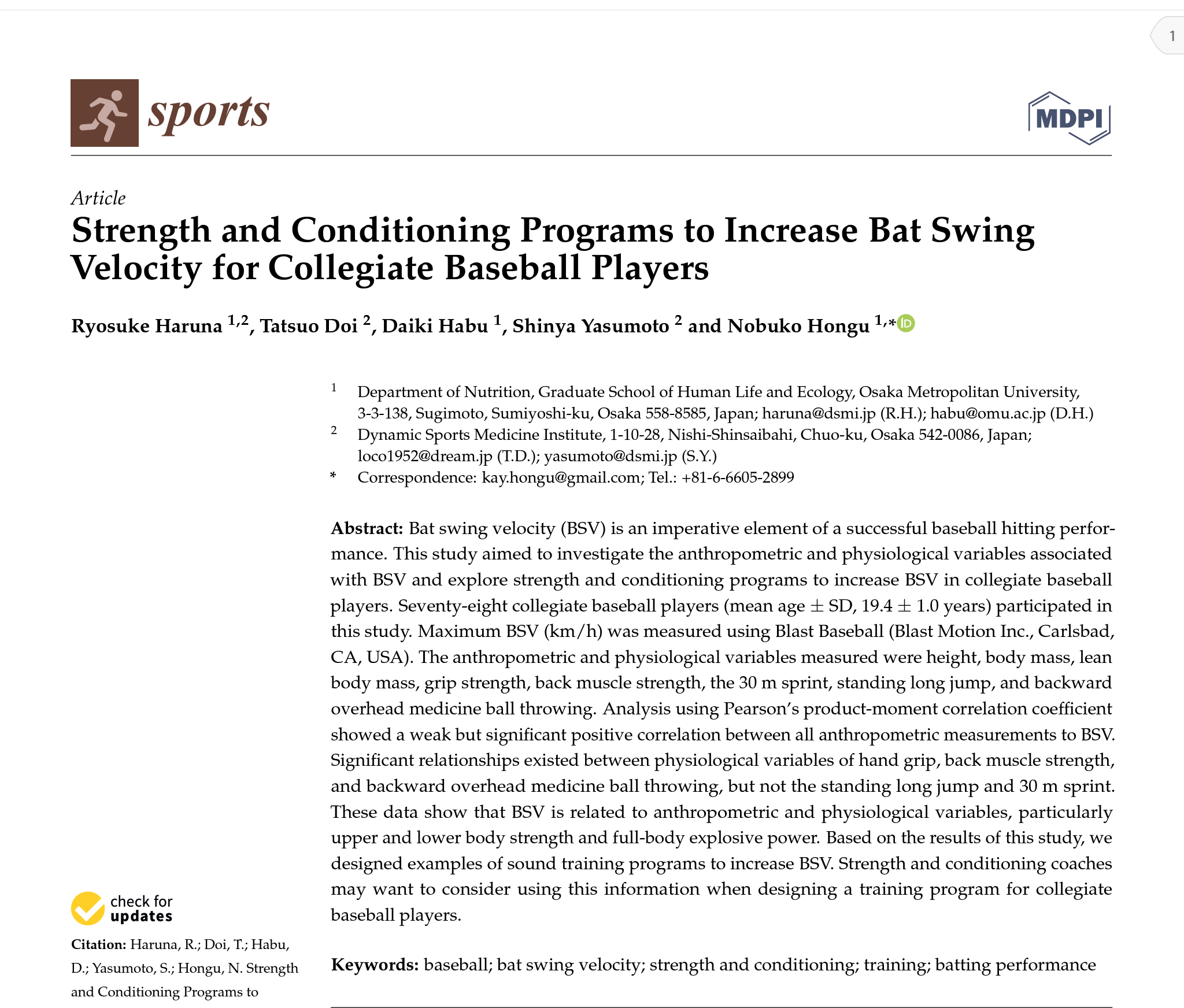
Strength and Conditioning Programs to Increase Bat Swing Velocity for Collegiate Baseball Players

Strength and Conditioning Programs to Increase Bat Swing Velocity for Collegiate Baseball Players

Haruna, R., Doi, T., Habu, D., Yasumoto, S., & Hongu, N. (2023). Strength and conditioning programs to increase bat swing velocity for collegiate baseball players. Sports11(10), 202.


Summary:

The study by Haruna et al. (2023) delves into the relationship between anthropometric and physiological variables related to bat swing velocity (BSV) among collegiate baseball players. It emphasizes that a higher BSV, crucial for hitting performance, correlates positively with various factors, notably body mass and muscle strength. The research involved 78 male collegiate players, assessing their height, body mass, and lean body mass, along with grip and back muscle strength, sprinting ability, and explosive power via standing long jumps and medicine ball throws. Results showed significant correlations between BSV and physical performance variables, particularly upper and lower body strength. Specifically, lean body mass and back muscle strength emerged as the most significant predictors of increased BSV. 


The study also categorized players into three performance levels based on BSV—Fast, Middle, and Slow—highlighting that those in the Fast BSV group exhibited superior body characteristics and muscle strength compared to their counterparts. It advocates for tailored strength and conditioning programs that focus on improving muscle strength and body conditioning to enhance BSV. 


The authors propose integrating baseball-specific training into broader strength training regimens, including exercises such as the hang power clean and dynamic bat swing training, to optimize players’ performance. Additionally, they underline the importance of individualized training strategies tailored to each player's physical profile. 


While the research presents robust findings and implications for training, it acknowledges limitations, such as the inability to definitively establish causation due to weak correlation coefficients and a limited sample size. The study calls for longitudinal research to better understand BSV determinants and their effects on overall baseball performance, particularly in relation to batting averages. This comprehensive analysis sheds light on the essential link between physical conditioning and batting capabilities, serving as a guide for coaches and trainers in optimizing player development in collegiate baseball.


Article link

Sunday, December 29, 2024

Torso rotational strength contributes to bat speed

The positive correlation between trunk, leg, and shoulder strength and linear bat velocity at different ball locations during the baseball swing in adult baseball hitters


    The study examines the correlation between trunk, leg, and shoulder strength and bat velocity in adult baseball hitters, particularly considering different ball locations within the strike zone. The researchers aimed to identify how various muscle strengths contribute to bat speed and which segment's strength serves as the best predictor for this speed. Nineteen male amateur and collegiate baseball players participated in the study, where they were tested for isokinetic strength and bat velocity at five specific ball locations: middle, high inside, high outside, low inside, and low outside. The findings revealed significant positive correlations between trunk rotation strength and bat velocity across all positions. 

    Although knee strength also showed correlations at most locations, shoulder strength was only significant for outside pitches. Through multiple regression analysis, trunk rotation strength emerged as the sole significant predictor of bat velocity regardless of the ball's position. The average bat velocities recorded were comparable to published studies, emphasizing the importance of trunk strength in baseball swings. 

    Additionally, the stronger the hitter's trunk rotation, the higher the bat velocity achieved, underscoring its critical role in generating force rapidly. Lead knee extension strength also correlated positively with bat velocity for several positions, indicating its role in stabilizing the pelvis and facilitating energy transfer. However, the correlation with shoulder strength was limited, only observed with outside pitches, suggesting that this segment might be more crucial when the hitter reaches for pitches away from the body. 

    The study concludes that enhancing trunk rotation strength could benefit hitters looking to improve bat velocity, although peripheral muscle groups, despite not being significant predictors, remain essential for overall swing mechanics. The results indicate that further research is needed to explore other contributing factors, especially for pitches inside the strike zone, where strength alone may not fully explain swing outcomes. Overall, the insights from this study emphasize targeted physical training to develop specific muscle groups for improved baseball performance.


Citation:

Chu, Y., Keenan, K., Allison, K., Lephart, S., & Sell, T. (2015). The positive correlation between trunk, leg, and shoulder strength and linear bat velocity at different ball locations during the baseball swing in adult baseball hitters. Isokinetics and exercise science23(4), 237-244.


Link to study

Friday, January 12, 2024

Strength and Conditioning Programs to Increase Bat Speed in College Players

Bullets from the study:

  • Greater strength, power, lean body mass = higher bat speed
  • All anthropometric variables(height, mass) were associated with bat speed
  • 3 performance variable had weak statistically significant association with bat speed 
  • Baseball specific training APPLIES power to swing - power+coordination+timing
  • The average bat speed for this college group was 65.37 mph with a range of 56.23 to 76.6
  • The authors provide suggests for each group of players based on their results


Summary


"Strength and Conditioning Programs to Increase Bat Swing Velocity for Collegiate Baseball Players" investigates the anthropometric and physiological variables associated with bat swing velocity (BSV) and explores strength and conditioning programs to increase BSV in collegiate baseball players. The study involves 78 male collegiate baseball players, and various measurements were taken including BSV, anthropometric measurements (height, body mass, lean body mass), grip strength, back muscle strength, standing long jump, and backward overhead medicine ball throwing. The results show that BSV is correlated with anthropometric and physiological variables, particularly upper and lower body strength and full-body explosive power. The study suggests that strength and conditioning coaches may consider using this information when designing training programs for collegiate baseball players.


Subjects were divided into 3 groups (fast, middle, slow) based on performance.  The table above shows the difference in characteristics between groups.


Solid description of baseball-specific training from this study.  Baseball specific training APPLIES power to the swing and includes both coordination and timing.


Link to article


Haruna, R., Doi, T., Habu, D., Yasumoto, S., & Hongu, N. (2023). Strength and Conditioning Programs to Increase Bat Swing Velocity for Collegiate Baseball Players. Sports11(10), 202.

Thursday, December 7, 2023

Core Training Program Improves Exit Velocity in High School Baseball Players

Straightforward here…


Rotational training program for HS baseball players improved batted ball exit velocity (measured off batting tee) by statistically significant 3.1 mph but did NOT improve throwing velocity

Click to enlarge

  • 24 high school baseball players (age 14-18) were randomly split into 2 groups - control and rotational training (RT).  
  • Both groups did the same baseball practice twice per week for 2-hours each practice.
  • The RT group did an additional 1-hour session after school 2x/week for 6 weeks. 
  • The RT program consisted of several exercises (see image below) with weighted walks loaded ~50% bodyweight for ~27m and ~1-3 sets of ~8-20 reps (details in the article linked at bottom of page).

Click to enlarge

Summary:

This paper investigates the effects of core training on high school baseball performance. The study aimed to explore the effectiveness of a resistance training program targeting the muscles of the core in order to increase force production in torsional movements such as throwing and hitting in baseball. The study involved 24 male high school baseball players who were randomly assigned to either a control group or a core training group. The control group attended baseball-specific workouts twice a week for six weeks, while the core training group participated in a six-week core training program in addition to the baseball-specific practice. Throwing velocity and ball-exit velocity were assessed before and after the six-week intervention period using a radar gun. The results showed that neither group experienced an increase in throwing velocity, but the core training group did experience a significant increase in ball-exit velocity. The study concluded that a six-week core training program led to increased ball-exit velocity among high school baseball players.

Click to enlarge


Summary:

This paper investigates the effects of core training on high school baseball performance. The study aimed to explore the effectiveness of a resistance training program targeting the muscles of the core in order to increase force production in torsional movements such as throwing and hitting in baseball. The study involved 24 male high school baseball players who were randomly assigned to either a control group or a core training group. The control group attended baseball-specific workouts twice a week for six weeks, while the core training group participated in a six-week core training program in addition to the baseball-specific practice. Throwing velocity and ball-exit velocity were assessed before and after the six-week intervention period using a radar gun. The results showed that neither group experienced an increase in throwing velocity, but the core training group did experience a significant increase in ball-exit velocity. The study concluded that a six-week core training program led to increased ball-exit velocity among high school baseball players.


Link to article


Felion, C. W., & DeBeliso, M. (2020). The effects of core training on high school baseball performance. Athens J. Sports7, 173-188.

Wednesday, November 29, 2023

Power characteristics in youth golf - Isometric Mid-Thigh Pull and swing performance

Really good paper here with loads of great info…

Start with this one:

Performance is MULTI-FACETED - in other words, training just for speed/power, approach or mechanics in isolation likely won’t cut it.  A well-rounded program is multi-disciplinary and multi-faceted.  Work on all of it!

Second:

There was a NEAR PERFECT correlation (r=.91) between peak force on the isometric mid-thigh high pull test and carry with the 6-iron and driver.  Pretty incredible strength of relationship


Third:

This study contributes to a growing body of evidence between physical power characteristics and swing performance.


Lastly:

Both movement competency and power are related to swing performance 


Summary:

The document discusses a study that aimed to determine the relationship between isometric mid-thigh pull (IMTP) force-time characteristics and swing performance in high-level youth golfers. Thirteen high-level youth golfers performed IMTP and swing testing, and the results revealed significant correlations between IMTP peak force and measures of swing performance such as club head speed (CHS) and carry distance. The study suggests that maximal lower body force production is important for swing performance in youth golfers and supports the use of IMTP as a testing tool in this population.


Link to article


Coughlan, Daniel; Taylor, Matthew J.D.; Jackson, Joanna; Ward, Nicholas; Beardsley, Chris. Physical Characteristics of Youth Elite Golfers and Their Relationship With Driver Clubhead Speed. Journal of Strength and Conditioning Research 34(1):p 212-217, January 2020. | DOI: 10.1519/JSC.0000000000002300


Isometric Mid-thigh high pull demo:


Sunday, November 26, 2023

Bat head speed and acceleration model comparison

TRANSLATING technical information to practical application with coaches & players is important.


Especially with visualizations to improve “mental representations” (as described by Anders Ericcson in “Peak”).


This is a representation (on the right side) of a Major League Baseball swing path/plane in comparison to a model (on the left side) provided by Robert Adair in his book “The Physics of Baseball”.   The animated model shows a graph of bat head speed acceleration as well as an acceleration heat mat as the bat accelerates and decelerates during the swing.


Thursday, November 23, 2023

When and how does bat speed happen?

This study measured the kinetics of bat speed in 99 amateur players with an average age of 19 years old. 

Bat angular velocity and bat head speed increase simultaneously around the half-way point of the swing (this looks like the time of when stride foot or heel lands, but is not specified in the study other than the image below) and they increase together until around the 80% mark.

The angular velocity is then converted to translational bat head speed into contact.

An interesting finding was that torque created in the X-Y directions did NOT have a significant relationship to bat speed.  The authors cited that torque exerted by the wrists is small compared to the amount of bat speed that gets created. 


Summary:

The document is a scientific study that aims to identify mechanisms to increase bat head speed in baseball batting. The study recorded the batting motion of ninety-nine amateur baseball players and analyzed the kinematics and kinetics of the bat. The results showed that the bat's rotational power increased with the torque exerted on the bat's grip, but declined just prior to impact. On the other hand, the bat's translational power increased just prior to impact. The study concluded that the bat's energy, by the application of rotational and translational power at different times, contributes to an increase in bat head speed in baseball batting. The study highlights the importance of increasing bat head speed in improving the performance of baseball batters.


Link to article 

Horiuchi, G., & Sakurai, S. (2016). Kinetic analyses on increase of bat head speed in baseball batting. International Journal of Sport and Health Science14, 94-101.

Thursday, November 16, 2023

Rotational medicine ball throw relationship to throwing velocity, bat speed and exit velocity

Rotational medicine ball (6#) throw showed a moderate, statistically significant relationship to throwing velocity, bat speed and exit velocity (off a tee) in college (division 3) baseball players. 

The average velocities were:

MB throw - 25.3 mph

Bat speed - 73.8 (measured with blast motion sensor)

Exit velocity - 83.6

Pitching velocity - 81.9


Article Summary:

The document is a research study titled "Rotational Medicine Ball Throw Velocity Relates to NCAA Division III College Baseball Player Bat Swing, Batted Baseball, and Pitching Velocity." The study aims to determine the relationship between rotational medicine ball throw velocity (RMBTV) and bat swing velocity, batted baseball velocity, and pitching velocity in collegiate baseball players.

The study involved 35 NCAA Division III players, including 15 pitchers and 23 hitters. The players participated in various whole-body power tests, including the two-legged standing broad jump for distance, lateral-to-medial jump for distance, and RMBTV. The researchers measured the correlational relationship strength between these tests and bat swing velocity, batted baseball velocity, and pitching velocity.

Results showed that moderate relationships were observed between bat swing velocity and RMBTV, pitching velocity and RMBTV, and batted baseball velocity and RMBTV. However, no significant relationships were found between the two-legged standing broad jump for distance or the lateral-to-medial jump for distance tests and bat swing velocity or pitching velocity.

Based on these findings, the researchers suggest that RMBTV may be a more reliable indicator of bat swing velocity, batted baseball velocity, and pitching velocity in collegiate baseball players. They also propose that further studies should explore whether coordination developed during RMBTV movements can help prevent shoulder and elbow injuries in baseball players.


Link to abstract


Taniyama, Daiki; Matsuno, Jun; Yoshida, Kei; Pyle, Brandon; Nyland, John. Rotational Medicine Ball Throw Velocity Relates to NCAA Division III College Baseball Player Bat Swing, Batted Baseball, and Pitching Velocity. Journal of Strength and Conditioning Research 35(12):p 3414-3419, December 2021. | DOI: 10.1519/JSC.0000000000004148


Wednesday, November 15, 2023

Newer twist on weighted implement training

Some of the best research on weighted implement training (overload/underload or heavy/light bats) for bat speed were done back in the 1980s and 90s.  This one is more recently done in 2019.

Japanese college baseball players with an average age of 20 years old slightly improved their bat speed with either a very light (8.8, 10.6 ounce) bat or a heavy (38.8 ounce) bat.  The training protocol was 100 dry swings twice per week for 8 weeks.  

Both groups had statistically non-significant improvements in bat speed.  The light bat group improves by 2.17 mph and the heavy bat by 1.3 mph on average.  The training was performed concurrently with existing activities. 


Article summary:

The article discusses the effect of dry swing training with a light bat on bat speed in baseball players. The study aimed to determine if dry swing training with a light bat would increase post-dry swing training bat speed compared to training with a heavy bat. A total of 34 male university baseball players were randomly divided into a light bat group and a heavy bat group. They performed 100 dry swings per day, twice a week for eight weeks. Bat speed and muscle power were measured before and after the intervention. The results showed that there was no significant interaction between the intervention and bat speed, knee extension strength, shoulder horizontal flexion, or hand grip strength. However, there was a main effect of the intervention on bat speed and shoulder horizontal flexion. Both groups showed an increase in bat speed, but there were no significant differences between the light bat and heavy bat groups. The study suggests that dry swing training with a light bat may be more effective and less strenuous.


Link to article

Yano, Y., Yabe, K., Okuno, S., Nagao, R., Naka, K., Honma, K., Yamamoto, S., & Iwata, A. (2019). Dry swing training with a light bat increases bat speed. Journal of Human Sport and Exercise14(4), 918–924. https://doi.org/10.14198/jhse.2019.144.19

Monday, November 13, 2023

Relationship between physical characteristics of college baseball players and bat speed

This study measured physical characteristics and performance tests of 78 college baseball players in Japan and calculated correlations to bat speed measured by a blast motion sensor.  The article is more of a correlational study with training suggestions provided at the end. Body mass and lean body mass has the strongest relationships to bat speed. 

Article summary:

The document is a research article titled "Strength and Conditioning Programs to Increase Bat Swing Velocity for Collegiate Baseball Players." The study aims to investigate the relationship between anthropometric and physiological variables and bat swing velocity (BSV) in collegiate baseball players and to explore strength and conditioning programs to increase BSV. The study included 78 male collegiate baseball players, and BSV was measured using Blast Baseball. Anthropometric and physiological variables measured included height, body mass, lean body mass, grip strength, back muscle strength, 30 m sprint, standing long jump, and backward overhead medicine ball throwing. 
The analysis showed a weak but significant positive correlation between all anthropometric measurements and BSV. Significant relationships were also found between physiological variables of hand grip, back muscle strength, and backward overhead medicine ball throwing, but not the standing long jump and 30 m sprint. The results indicate that BSV is related to anthropometric and physiological variables, particularly upper and lower body strength and full-body explosive power. The study suggests designing training programs based on the results to increase BSV for collegiate baseball players.


Haruna, R., Doi, T., Habu, D., Yasumoto, S., & Hongu, N. (2023). Strength and Conditioning Programs to Increase Bat Swing Velocity for Collegiate Baseball Players. Sports (Basel, Switzerland)11(10), 202. https://doi.org/10.3390/sports11100202

Saturday, November 11, 2023

Bench Press and Bat Speed


Article summary:

The document is a research study about the relationship between upper-body strength and bat swing speed in high-school baseball players. The study aimed to examine the physical characteristics of home run hitters and determine if there was a correlation between upper-body strength and bat swing speed. The subjects were 30 male high-school baseball players with national tournament experience. Bat swing speed was measured using a microwave-type speed-measuring instrument, and upper-body strength was measured using one-repetition maximum (1RM) bench press, bench power, and isokinetic chest press. The results showed significant correlations between bat swing speed and 1RM bench press, bench power, and isokinetic chest press. Home run hitters had higher values in bench power and isokinetic chest press per kilogram of body weight compared to mediocre hitters. The study concludes that to improve hitting power in high-school baseball players, it is important to develop both 1RM bench press and bench power with light loads.


Miyaguchi, Kazuyoshi1; Demura, Shinich2. Relationship Between Upper-Body Strength and Bat Swing Speed in High-School Baseball Players. Journal of Strength and Conditioning Research 26(7):p 1786-1791, July 2012. | DOI: 10.1519/JSC.0b013e318236d126


Thursday, November 9, 2023

Implement weight training programs

Dr. Coop DeRenne started studying and reporting on the effects of weighted implement training on throw and swing velocity back in the 1980’s.  This article from 1987 - Implement Weight Training Programs - is a bit of a summary of the baseball research on this topic at that point.


Summary:

The article discusses the implementation of weight training programs in baseball. It emphasizes the importance of specificity and safety in designing these programs. The ideal weight training program for baseball should include exercises that closely resemble the movements used in hitting and pitching. The article also mentions the use of implement weight training, which involves using modified standard baseball equipment to improve performance. DeRenne discusses the positive results of several research projects conducted at the University of Hawaii, which showed an increase in hitting and throwing velocities. The use of correctly weighted and balanced bats and baseballs was found to be effective in improving performance. The article concludes by mentioning the collaboration between professional baseball and collegiate programs to improve the game, and the availability of implement weight training equipment in the market.


Link to Article

DeRenne, Coop Ph.D.. BASEBALL: Implement weight training programs. National Strength and Conditioning Association Journal 9(3):p 35-37, June 1987.


Tuesday, November 7, 2023

Relationship of the trunk muscles to bat speed

Article:

Relationships between Bat Swing Speed and Muscle Thickness and Asymmetry in Collegiate Baseball Players


Article summary:

The purpose of this study was to examine the relationships between bat swing speed (BSS), muscle thickness, and muscle thickness asymmetry in collegiate baseball players. The study included twenty-four collegiate baseball players who participated in hitting a teed ball while their BSS was measured using a motion capture system. Muscle thicknesses of the trunk, upper limb, and lower limb were measured using ultrasonography. The study found statistically significant positive correlations between BSS and muscle thicknesses of the abdominal wall and multifidus lumborum on the dominant side of the body, while no significant correlations were found on the non-dominant side. No correlations were found between BSS and the lateral asymmetry of any muscles. The findings suggest the importance of trunk muscles for bat swing and the lack of association between BSS and muscle size asymmetry.


Link to article


Monday, January 23, 2023

The Effects of Various Weighted Implements on Baseball Swing Kinematics in Collegiate Baseball Players

Last 3 weeks have covered adaptations to weighted implement bat speed training over time (6-12 weeks). This study from Williams, et al. (2017) is much more recent and looks at acute changes to bat speed after warm-up (WU) protocols with different implements.

Basically, the study did not find a difference between 4 different WU protocols.  There was some conflict with previous research but the authors did a nice job discussing the different results, which were mainly attributed to studying different populations (D1 college players in this one compared to HS/recreational in others).

I also appreciate the description and explanation of “kinesthetic illusion” in this study because 75% of the players chose one specific WU protocol despite no significant differences being found in the actual results.

Lastly, I think it’s important to point out that a study like this may not produce statistically significant differences, but still show an actual difference (one MPH in this case).  And in the really world, even a small difference might be enough to improve performance. 


Link to article

Monday, January 16, 2023

Effects of Weighted Bat Implement Training on Bat Swing Velocity

     This study by DeRenne et al. (1995) reports the most significant bat speed improvement resulting from weighted bat training - a group of college players showed a 10% improvement in bat speed over a 12 week training period.  It’s short, 4-page, study that’s well worth the read (link at bottom of page).

    The training protocol included 4 training days per week with 150 total swings (15 sets of 10 swings).  Bat weights were alternated each set and the weights used were within 12% of the regular game bat (27-29 oz for light bats and 31-34 oz for heavy bats). Very interestingly, there was no other practice or training during the study so the improvements of the study are attributed directly to the weighted implement training.

    There were 2 implement training groups (one used coach BP, the other used dry swings) which both improved, but the BP group improved 4% more.  The control group used only dry swings with regular bat and showed a 1% improvement.

    Between the Sergio & Boatwright (1993) study covered last week and this one, there are a couple different training protocols shown to significantly improve bat speed in college-aged athletes.  This should provide some guidance for programming and also flexibility depending on the time of year and training resources available.  It’s possible to combine weighted implement training effectively with concurrent practice and resistance training, and also possible to focus solely on bat speed training with a higher volume of swings.


Link to article 

Monday, January 9, 2023

Training Methods Using Various Weighted Bats and the Effects on Bat Velocity

If you’ve never read a research study on baseball training, start with this one.  It’s just 3 pages long and gets right to the point.  College players trained to increase bat speed 3x/week for 6 weeks by taking 100 swings (20 sets of 5) with various weighted bats.  The players were split into 3 groups (regular bat, heavy bat only, and heavy bat plus fungo bat).  Each group improved bat speed similarly - they gained an average of 8% bat speed.

It’s also notable, to me, that this 6 week training block coincides with typical pre-season practice and my interpretation of the article is that the authors implemented the bat speed training in addition to regular practice. 


Link to study

Monday, January 2, 2023

Effects of Baseball Weighted Implement Training: A Brief Review

We’re starting a series on bat speed training research with a 2009 summary of literature from Dr. Coop DeRenne and Dr. David Szymanski titled “Effects of Baseball Weighted Implement Training: A Brief Review”.  This paper summarizes research on weighted implement training (heavy/light baseball and bats) for both pitching and hitting.  I’m posting summary of the bat speed training for practical purposes, but the  paper provides a a history of implement training going back to Soviet track and field from the 1970’s and 80s.  The list of references (there are 45!) in a paper like this is also very helpful if you are interested in learning more.


Here’s an adapted summary table of the research:


Happy to notice that each research study demonstrated successful results in improving bat speed!  We’ll take a close look at each study in the upcoming weeks…